Parallel parking has a reputation problem. Drivers who merge across four lanes of highway traffic without blinking will circle a block three times to avoid a curbside spot, and plenty of licensed adults quietly arrange their lives around never having to do it. The irony is that parallel parking is the most learnable maneuver in driving — it happens at walking speed, it follows the same geometry every single time, and it can be reduced to a short sequence of reference points that works in almost any car. This guide teaches that repeatable method, plus how to judge whether a space is big enough, how to fix an attempt that goes crooked, and how to practice until the whole thing takes thirty unremarkable seconds.
Why a Method Beats Instinct
Most people fail at parallel parking because they try to steer by feel, improvising a curve into the space and correcting frantically when it goes wrong. But the geometry of sliding a car into a curbside gap does not change from day to day. If you start from the same position and turn the wheel at the same landmarks, the car traces the same path every time. Professional driving instructors teach reference points for exactly this reason: they turn a judgment problem into a checklist. Your job is not to be talented; it is to hit three marks in order, slowly.
One mindset shift helps before any technique: go slower than feels natural. At a crawl, every mistake is small and fixable, and you have time to check mirrors continuously. Speed is what turns a slightly wrong angle into a bumped wheel or a startled pedestrian.
Step 1: Choose and Size the Space
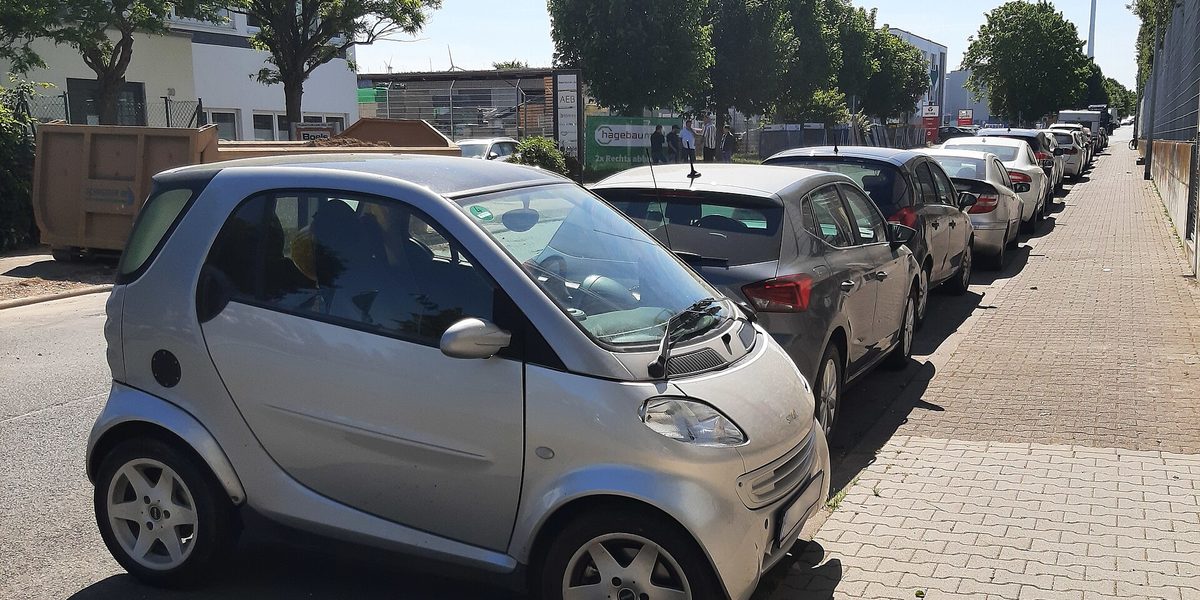
A workable gap needs to be about one and a half times the length of your car — with practice you can manage less, but while learning, be choosy. As you approach, slow down early and signal toward the curb so traffic behind understands what you are doing; drivers deal with parallel parkers constantly and will wait, especially when your intentions are obvious.
Glance at the space as you pass it. Check for the things that disqualify a spot regardless of size: fire hydrants, driveways, crosswalk zones, signage restricting parking, and debris or glass at the curb. Also note how the cars ahead and behind the gap are positioned — if one of them is parked far from the curb, your sightlines and clearances change.
Step 2: Line Up in the Starting Position
Pull forward until your car sits parallel to the vehicle in front of the space — the one you will park behind — roughly an arm's-length to a meter away from its side, with your rear bumpers approximately even. This alignment is the foundation of the whole maneuver; a sloppy starting position guarantees a sloppy result. Stop fully, shift into reverse, and take a deliberate look around: both mirrors, over your right shoulder, and ahead for approaching cyclists and pedestrians. Your reversing lights now tell everyone nearby what happens next.
Step 3: The Three-Turn Sequence
- Full turn toward the curb, reverse to the pivot point. Turn the steering wheel all the way toward the curb (right, in right-hand traffic) and creep backward. Watch through the rear side window: when the back of your car points into the space and you can see the far corner of the space — or the near headlight of the car behind — centered in your rear window, stop. Another common landmark: your car sits at roughly forty-five degrees to the curb.
- Straighten the wheel, reverse into the gap. Bring the steering wheel back to center and continue slowly backward, letting the car slide diagonally into the space. Watch the mirror on the curb side; when your front bumper clears the rear corner of the car ahead, stop. That corner is your signal for the final turn.
- Full turn away from the curb, reverse until parallel. Turn the wheel fully away from the curb and keep creeping back. The nose of your car swings in, and the car settles parallel to the curb. Stop before you approach the car behind — use the mirror, not faith.
Finish by centering the wheel and pulling forward a little to balance the gaps ahead and behind. Done correctly, you end a hand-width or so from the curb with room for both neighbors to escape.
Fixing a Crooked Attempt
Even experienced drivers misjudge the pivot point sometimes. The repair is almost always the same: pull forward, not backward. If the car ends up angled with the nose sticking out, drive forward while steering toward the curb until the car straightens, then reverse straight back to center yourself. If you turned too early and your rear wheel is approaching the curb, pull forward out of the space partway and redo the final third of the maneuver.
And if the whole attempt collapses — wrong angle, traffic pressure, nerves — simply signal, pull out, and start over from the alignment position. A restart takes twenty seconds and looks far more competent than a seven-point struggle. Nobody watching remembers a clean second attempt; everybody remembers a panicked one. Waiting traffic can pass or wait — you are allowed to take the time the maneuver needs.
Reading Your Mirrors and Modern Aids
During the maneuver, your eyes should cycle continuously: curb-side mirror for distance to the curb and the car behind, traffic-side mirror for cyclists and passing cars, rear window for the big picture, and windshield for your front bumper's swing — the nose of the car sweeps outward during the final turn, and forgetting that is how front corners meet passing traffic.
Backup cameras, parking sensors, and cross-traffic alerts are genuinely useful — treat them as extra mirrors, not as the method itself. Cameras distort distance and sensors can miss low curbs and poles, so let the reference-point sequence drive your decisions and let the electronics confirm them. That way you can still park any car you rent or borrow, whatever it is equipped with.
Practice Until It Is Boring
Confidence comes from repetitions without stakes. Set up in an empty parking lot with two cones, trash bins, or cardboard boxes spaced a car-and-a-half apart along an imaginary curb line, and run the sequence ten times in a row. Note your own car's landmarks — where the space's corner appears in your rear window at the pivot, where the wheel needs to be — because every vehicle's turning circle differs slightly, and your reference points calibrate to it quickly.
Then graduate to a quiet residential street with generous gaps, and finally to real errands on busier streets at off-peak hours. Most people need only a couple of short sessions before the maneuver stops feeling like an exam. From there, ordinary life provides all the maintenance practice you need — start choosing the curbside spot instead of the distant lot, and the skill stays sharp forever.
Final Thoughts
Parallel parking is a sequence, not a talent: line up bumper to bumper an arm's length out, full turn to the curb until the space's corner fills your rear window, straighten and slide until you clear the front car's corner, full turn away until you are parallel. Move at a crawl, fix errors by pulling forward, and restart without shame when a setup goes wrong. Practice the marks a dozen times in an empty lot, and a maneuver that once dictated where you shopped and dined becomes exactly what it should be — thirty quiet seconds between you and the door.